
Spring Preparation for any Bowling Green: Full Guide

Get your bowling green ready for the new season.

Mid to late March.
Some of the links in this article go to Amazon or to our own shop. If you buy through them we may earn a small commission, at no extra cost to you. I only point you at products I would be happy to use myself.
This is the crucial time for getting the green ready for the new season. It is essential to be ready for the first real signs of Spring, in the north of the UK and Europe usually around mid to late March, up to two weeks beforehand further south.
As soon as there is a mild spell in March the grass is keen to get moving, to recover from Winter stresses. This is when the main Spring fertiliser should be applied. I have always found a high nitrogen fertiliser, with a high iron content, works best in these lower temperatures. The Spring fertiliser on our lawnsforyou.com shop, 9.0.0 + 11% iron, is an ideal starter for bowling greens. Find others here.
It is possible to make your own by mixing two parts sulphate of ammonia, one part sulphate of iron, and five parts dried sand, and applying at 35 grams per square meter. Get here. To make this mix even more effective add one part seaweed meal, a great soil conditioner. Get here.
The cutting height should be dropped by one mil at this stage, which should take the mowing height to around 6mil, and cutting frequency up to twice per week. Do not use groomers if fitted to the mower.
Early April till opening day.
Scarifying is required in early April to remove the dead moss. Scarifying also opens up the grass sward by removing dead and dying material, which forms thatch. Ideally a thatch control reel should be used, not a thatch removal reel, which can be overly aggressive for Spring use.
A wetting agent, along with seaweed liquid, both found here, or contact us for a quote, should be applied after the scarifying.
A week or so before opening day lower the cutting height to 5.5mil, and cut three times over the next week, then lower again to 5mil for mowing on opening day. Continue to mow at least three times per week. It is a fact that more regular cutting produces better, more uniform, playing surfaces. Most top class facilities now mow at least every day, and often double cut for tournaments.
I have not yet mentioned rolling, which can be a contentious subject. This is because most clubs do not have access to a suitable roller, that is a dual or triple push or ride on roller, which rolls evenly and minimises compaction. The old Australian roller was very common on bowling greens, and does a good job, as does the new ride on rollers, which can be hired for special occasions.
Rollers can increase speed, without reducing cutting heights, thereby reducing stress on the grass. My own feeling is that very regular mowing, with a well set mower, will provide surfaces suitable for most bowling clubs.
If the above instructions are followed, the bowling green should be in good condition, and ready for play commencing on the club opening day.

The month on the green, in your inbox
Short emails with the jobs for your green in the order I would do them, and what to order before the rush. Free, and you can leave any time.
From me, and never passed on.
Your spring timetable
Most of a good spring is decided before March. These are the dates I work to:
- By mid-February: the spring order in with your supplier, so it is on site by early to mid-March.
- Early March: the mower back from its service, sharp and properly set. If it is your only mower, book it in for February.
- Early March: the watering system recommissioned and checked, and working by the start of April. Dry east winds in spring can take the moisture out of a green very quickly.
- Mid to late March: the spring feed on in the first mild spell, as above.
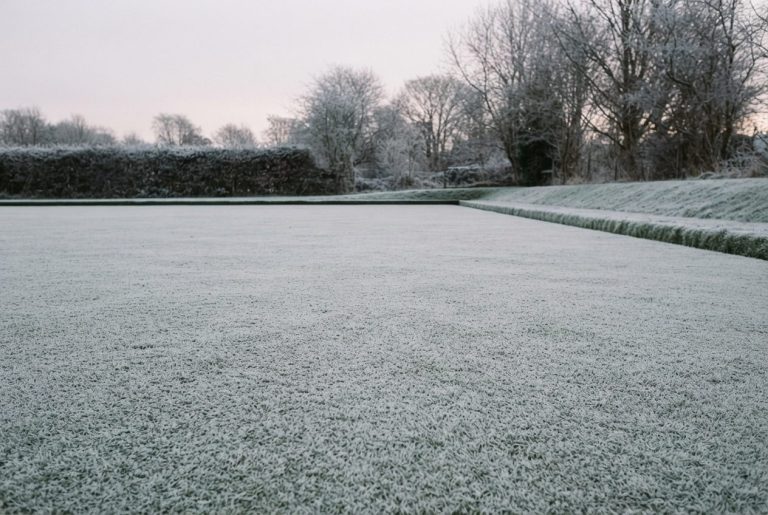
- All through March: still no work on the green while there is a white frost on it.
What your green should look like by the end of April
By the end of April you are into the playing season, and the green should look really good: cut down to 4 or 5 mm depending on where you are in the country, and mown three to four times a week. If it is thin, yellow or patchy by then, the cause usually goes back to last autumn or the winter, and my autumn renovation and winter routine articles are where to look. Every month is on one page in my free bowling green maintenance calendar (PDF).
For ongoing advice, have a look at my guide to a full year’s maintenance of a bowling green. I can also provide a service which gives a personalised report on individual greens, along with all the materials required for the year.
Bowling green package
A year's products and my programme
Everything your green needs for the year, and when to put it on. Setting your 2027 budget? Start here.
About Duncan Gray
I spent my working life in greenkeeping: head greenkeeper at Lahinch, then in charge of nine bowling greens for Kyle and Carrick, including Ayr Northfield for the World Championships. Now I help clubs look after their own greens.
Ask Duncan about your green
Our bowling green has a lot of grass going to seed, bowls England say keep grass at8mm,should I cut low to rid the seed heads
Hi Ken, thanks for getting in touch. I would say 8mil too high. In my recommendations for maintenance during lock down I have recommended 7mil maximum, but if you have a lot of seeding poa (annual meadow grass) I would even go to 6mil. The best tool for getting rid of seed heads is a comb on the mower, but most now just have a groomer fitted.
At these higher cutting heights you can be aggressive with the groomer, setting it to touch the the height setting bar. You can also verticut, as this would be classed as essential maintenance to control seeding of meadow grass.
An application of liquid nitrogen fertiliser with seaweed will also help to stop seeding, as it is a survival tool for this short lived annual grass when under stress.
I hope this helps you. Regards, Duncan.